




Yuroz Functional Art “Together in Time” Cocktail Table
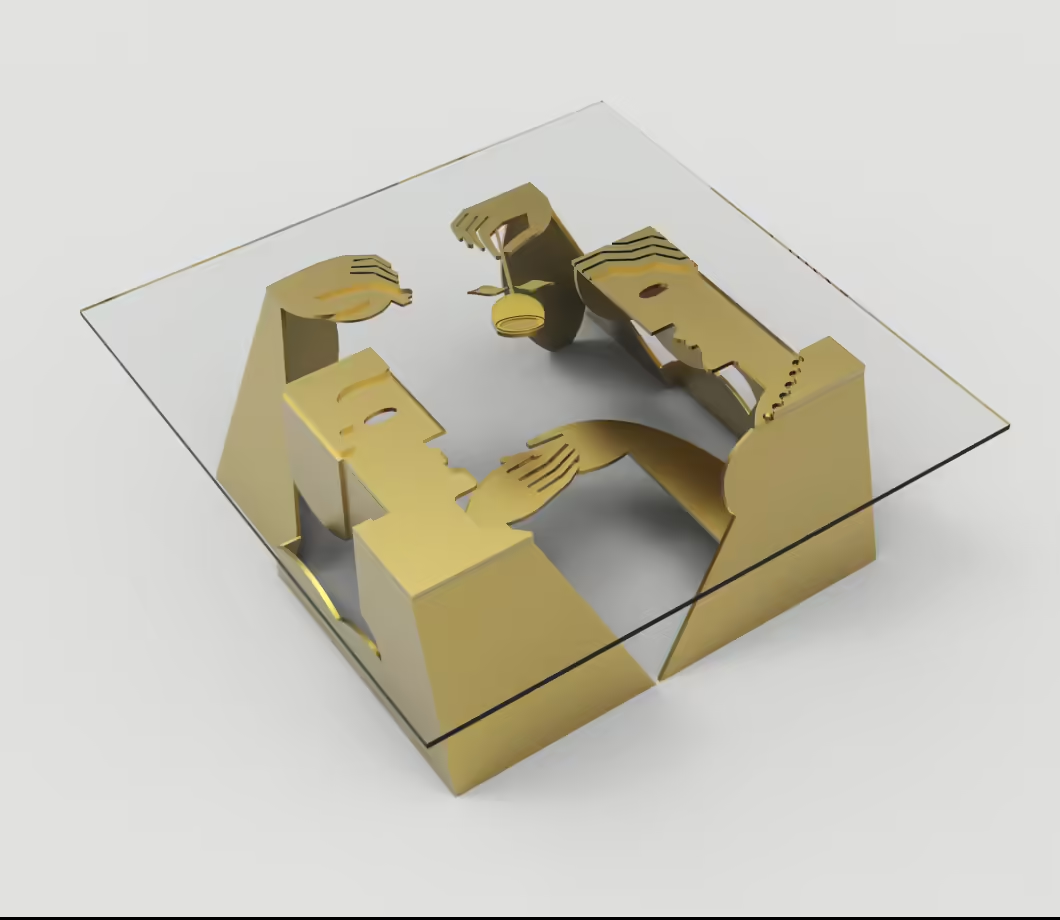
“Together in Time” Yuroz Functional Art Cocktail Table features 24k Gold Leaf or Venetian Silver on steel frame.
Fusing human sensuality into metal. YUROZ “Art You Can Touch” immortalizes emotions into one of a kind metal etched tabletops with Yuroz signature symbolism and narratives.
In Together in Time, Yuroz moves the language of ICONO off the wall and into the room, transforming intertwined figures, hands, and symbolic forms into a sculptural coffee table finished in gold leaf on steel beneath glass.
The title shifts the work from mere togetherness to duration: not simply two people joined in a moment, but two lives measured against time, held in relationship, and made part of the architecture of daily living.
One does not merely look at this work. One gathers around it, lives with it, and quite literally places time together at the center of the room, be it a square, rectangular, round or oval table top, shaping the intimacy, discernment, and depth of those conversations as viewers gather.
Together in Time
A sculptural ICONO work in gold leaf on steel beneath glass, conceived not simply to be viewed, but to become part of the space where life is lived. There is a fundamental difference between looking at an image of intimacy and allowing intimacy to occupy physical space.
Together in Time makes that distinction tangible.
Yuroz takes the visual language associated with his ICONO Collection and removes it from the conventional picture plane. The figures no longer exist only to be viewed from a respectful distance. Their elongated hands, intersecting profiles, and abbreviated forms become part of an object around which people actually live.
That change of function alters the work.
A painting is encountered frontally.
A table is approached from every direction.
A painting asks for contemplation.
A table invites gathering.
And that may be why Together in Time is such a natural extension of Yuroz’s iconographic vocabulary.
The work is structured around human connection, but connection here is no longer simply represented. It is enacted by the object itself.
People sit around it.
Conversations happen over it.
Books accumulate on it.
Glasses are set down.
Hands reach across it.
Time passes around it.
The title therefore becomes unusually important.
Together in Time does not describe only proximity.
It describes continuity.
To be together is one thing.
To remain together through time is another.
That distinction gives the work more emotional weight than its functional form might initially suggest.
The figures appear reduced to essential geometry.
Faces, hands, bodies, and gestures have been simplified into sculptural silhouettes and linear contours. That reduction is consistent with Yuroz’s ICONO language, where unnecessary detail is stripped away so that gesture and relationship become more legible.
The hands are especially important.
In Yuroz’s work, hands frequently carry emotional information that faces do not.
They offer.
Receive.
Hold.
Protect.
Reach.
Here, they are enlarged and isolated enough to become almost architectural elements.
One hand does not simply belong to a figure.
It becomes a gesture made permanent in steel.
That transformation matters.
The emotional exchange between two people is ordinarily fleeting.
A touch happens and disappears.
A hand reaches and withdraws.
An embrace loosens.
A moment becomes memory.
Gestures acquire weight, structure, and permanence in Together in Time
They support an object.
They hold space.
They become part of the room.
This is where the use of gold leaf becomes more than decorative.
Gold has long carried associations with permanence, value, radiance, and transcendence. In Yuroz’s ICONO works, gold helps elevate ordinary human moments beyond the incidental. Here, that same strategy is applied not to a framed image, but to a utilitarian form.
The effect is subtle but consequential.
The table becomes an argument.
It proposes that the shared spaces of everyday life may deserve the same degree of artistic elevation as the formal spaces traditionally reserved for art.
That is precisely why this work should not be treated as merely “decorative furniture.”
Its strength lies in the tension between function and symbolism.
It is usable.
It is sculptural.
It is relational.
And it carries the iconographic language of Yuroz into a different register.
The glass top adds another layer.
Glass permits visibility while creating distance.
We see through it.
We see the sculptural forms beneath it.
We place objects upon it without entirely obscuring what lies below.
That relationship between transparency and support is particularly apt for a work concerned with time and companionship.
The visible structure remains beneath the surface.
Present, even when attention shifts elsewhere.
The steel contributes a different quality.
Steel is materially resistant.
It is not fragile.
It does not suggest ephemerality.
That makes it an interesting vehicle for imagery built around human connection.
Emotion is fleeting.
Steel is not.
Memory is unstable.
Structure endures.
Gold leaf introduces luminosity to that permanence.
The resulting combination is almost paradoxical: a warm symbolic language executed through an industrial substrate.
That contrast gives the piece authority.
It is not sentimental because the material will not allow it to become sentimental.
The steel keeps it grounded.
The gold keeps it elevated.
The glass keeps it open.
The figures keep it human.
The title keeps it temporal.
That balance is why the work succeeds as collectible design rather than simply as an applied motif.
The forms are not placed onto a table after the fact.
They appear to generate the table’s identity.
The figure becomes structure.
Gesture becomes support.
Relationship becomes function.
This is the distinction I would emphasize on Moso.
Together in Time is not merely an ICONO image adapted to furniture.
It is ICONO translated into inhabitable form.
Functional Art, When Fine Art Fuses With The Living Environments
That makes it particularly relevant to collectors who do not separate fine art from the environments in which they live.
Some works demand wall space.
Others change the room.
This one does both conceptually, even though it occupies the floor.
The coffee table has always been one of the most socially charged objects in a domestic interior.
It sits between people.
It occupies the center of seating arrangements.
It receives what we are reading, drinking, discussing, or temporarily setting aside.
It is a surface around which time is spent.
That makes the title Together in Time almost uncannily apt.
The work does not simply depict togetherness.
It facilitates it.
Two people sit opposite one another.
The table remains between them.
Yet the imagery embedded within it turns that separation into connection.
There is something quietly intelligent about that.
The object becomes both divider and bridge.
Both surface and symbol.
Both sculpture and participant.
Yuroz’s ICONO language has always been concerned with elevating overlooked human experience.
Here, the overlooked experience is not a dramatic romantic moment.
It is the far more ordinary fact of sharing space over time.
The room.
The conversation.
The pause.
The accumulated hours.
The repeated return to the same place with the same person.
That is where the work becomes emotionally persuasive.
Grand declarations are easy to commemorate.
Routine is harder.
Yet routine is where most relationships actually live.
Together in Time gives material form to that truth.
It asks whether a shared life is made meaningful by singular moments, or by repetition.
By returning.
By sitting down again.
By placing another glass on the same surface.
By reaching across it.
By remaining.
And perhaps that is why the work belongs so naturally within the broader ICONO conversation.
The collection has always taken ordinary human experience and granted it visual dignity.
This table takes the next step.
It grants that experience physical space.
The result is not simply something to view.
It is something to live around.
And over time, that may be the most appropriate destiny for an object titled Together in Time.
Be the first to review “Yuroz Functional Art “Together in Time” Cocktail Table”
You must be logged in to post a review.

Reviews
There are no reviews yet.